Farming on Crutches: War Amputees Growing Sierra Leone's Food Future
Sierra Leone
Agriculture, Community, Education$22,503
USDTotal funded by 136 donors with matching
FA
Farming on Crutches
Sierra Leone
Community GroupFarming on Crutches is a grassroots initiative in Sierra Leone founded by Mambud Samai, himself a civil war refugee. Sierra Leone's war left an estimated 28,000 people without limbs; twenty years on, many still live in poverty, excluded from physical work. Farming on Crutches exists to change that. On a three-acre demonstration farm outside Freetown, the program runs a one-week intensive training teaching amputees regenerative farming — seed saving, bokashi making, irrigation, and crop rotation — using only local resources. Guided by the ethos "We are not mere victims of war but Ambassadors of Peace," graduates leave with knowledge, tools, seeds, and a small sum to start farming. Since 2020, over 100 amputee farmers have been trained, generating livelihoods, strengthening local food systems, and proving that disability is not inability. Farming on Crutches is a programme by the Single Leg Amputee Sports Association (SLASA) in Sierra Leone.
BE
Be The Earth Foundation
United Kingdom
NonprofitBe The Earth is a living lab for eco-centric economies. We are experimenting with ethical ways to redistribute wealth and regenerate ecosystems. We are part of a global movement of individuals and organisations committed to nurturing life and nature. Together, we create economies that prioritise the regeneration of all life over the pursuit of profit and power.
Project story
My name is Mambud Samai. I grew up in Sierra Leone, survived its civil war, and spent years in a refugee camp watching amputees struggle to find a place in a world that no longer saw them. When I discovered regenerative farming on a nine-month learning journey in Japan, I saw something unexpected: not just a way to grow food, but a way to restore dignity and belonging.
That vision became Farming on Crutches (FoC).
Today, I don't stand alone. Lahai, Mustapha, Elizabeth, and over 100 trained amputee farmers have transformed personal adversity into agricultural leadership across Sierra Leone. Together, we've spent five years building an answer to a crisis now reshaping West African farming.
And at the heart of everything we teach has always been Bokashi.
Our Mission
Farming on Crutches believes in the power of healthy soil to heal people, communities, and land. We believe that every farmer — regardless of ability, background, or resources — deserves access to knowledge that makes them sovereign over their own food. This project extends that mission beyond our amputee community to every smallholder farmer in Sierra Leone facing an uncertain agricultural future, by establishing a Bokashi production hub that is self-sustaining ecologically, financially, and in knowledge.
The Crisis
Synthetic fertiliser costs have skyrocketed. For Sierra Leone's 70% of people dependent on small-scale farming, this is not abstract — it's survival.
Farmers who relied on chemical inputs are finding them unaffordable, while degraded soils compound the problem.
Farming on Crutches has spent five years quietly building the answer.
The Solution: Bokashi
On our three-acre farm outside Freetown, we've perfected Bokashi — a fermented organic fertiliser made entirely from materials Sierra Leone already has: poultry manure, rice husks, molasses, and indigenous microorganisms harvested from our Eastern Province forests. Rice husks are abundant waste from the country's staple crop. Molasses is widely available as a cattle feed additive. Charcoal dust and wood ash are by-products of everyday cooking. Nothing in this system depends on imports.
Our approach is grounded in the global work of Colombian agronomist Jairo Restrepo Rivera, whose methods span more than 52 countries. His core principle — Bokashi produced entirely from local materials, zero purchased inputs — is what we practise. This is a proven methodology, adapted to Sierra Leonean conditions by people with deep local knowledge and community trust.
The breakthrough? Once we capture forest microorganisms, they multiply indefinitely on-farm using only rice bran and molasses. The forest gives once. The farm sustains it forever.
The Goal
This funding will establish a bokashi production hub on FoC's existing three-acre farm outside Freetown: a covered fermentation space, a small free-range poultry unit producing eggs for income and manure for Bokashi, basic equipment, and a Krio-language instructional video carrying the full method to every Sierra Leonean farmer with a phone.
The farm is the starting point, not the ceiling. FoC's 100-plus graduates, already working across multiple districts, form a ready-made distribution and peer-training network.
As Bokashi moves through that network, the hub becomes a permanent supplier and knowledge centre for Sierra Leonean agriculture at large: not just for amputees, but for every smallholder facing an uncertain future.
The goal is a system that feeds itself.
How We Regenerate
We work from the soil up.
Bokashi restores microbial life to land depleted by chemical farming, rebuilding the biological foundation that healthy crops depend on. Our closed-loop poultry unit turns farm waste into fertility. Our IMO multiplication process means the forest ecology of Sierra Leone — the soil microorganisms of Sierra Leone's Eastern Province forests — is captured once and cycled through farms indefinitely, improving with every season. As soils recover, application rates reduce year-on-year and farms become genuinely self-sustaining.
We are not replacing one input dependency with another. We are ending dependency altogether.
Tracking Impact
In six months: the hub is producing Bokashi and supplying local farmers at prices well below synthetic fertiliser. FoC graduates are earning income through distribution and peer training.
In a year: participating farms show measurable improvements in soil health and yield. The Krio video is circulating through farming communities across Sierra Leone.
FoC has become something larger than a training programme — a permanent, community-owned knowledge resource for the country's agricultural future.
In Numbers:
1 production hub established on FoC's existing 3-acre farm
Estimated annual Bokashi production: 3–5 tonnes in year one
Target farmer reach: 50–80 farmers supplied directly via the FoC graduate network
20+ FoC graduates activated as peer trainers and distributors
Krio video target: 5,000+ views across farming communities in year one
Income generated through egg sales and Bokashi sales to reduce FoC's dependency on external funding
Agricultural outcomes, economic outcomes, and knowledge reach will all be tracked. Because this project is community-led, qualitative data matters too — how farmers describe their relationship to the land, their sense of autonomy, their confidence in the future.
"We are not mere victims of war but Ambassadors of Peace."
This project is what that looks like in practice: a community that survived the worst, growing the food that feeds the future.
Project updates
Team
Farming on Crutches: War Amputees Growing Sierra Leone's Food Future
Sierra Leone
Agriculture, Community, Education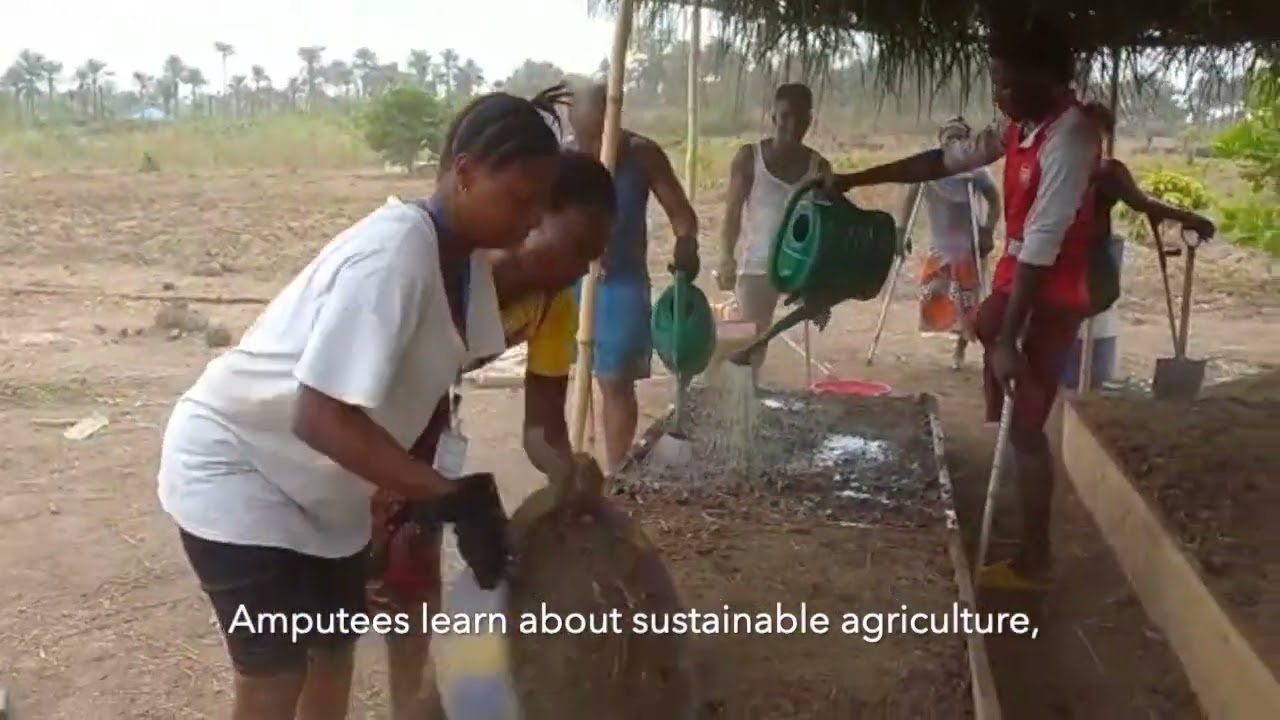
FA
Farming on Crutches
Sierra Leone
Community GroupFarming on Crutches is a grassroots initiative in Sierra Leone founded by Mambud Samai, himself a civil war refugee. Sierra Leone's war left an estimated 28,000 people without limbs; twenty years on, many still live in poverty, excluded from physical work. Farming on Crutches exists to change that. On a three-acre demonstration farm outside Freetown, the program runs a one-week intensive training teaching amputees regenerative farming — seed saving, bokashi making, irrigation, and crop rotation — using only local resources. Guided by the ethos "We are not mere victims of war but Ambassadors of Peace," graduates leave with knowledge, tools, seeds, and a small sum to start farming. Since 2020, over 100 amputee farmers have been trained, generating livelihoods, strengthening local food systems, and proving that disability is not inability. Farming on Crutches is a programme by the Single Leg Amputee Sports Association (SLASA) in Sierra Leone.
BE
Be The Earth Foundation
United Kingdom
NonprofitBe The Earth is a living lab for eco-centric economies. We are experimenting with ethical ways to redistribute wealth and regenerate ecosystems. We are part of a global movement of individuals and organisations committed to nurturing life and nature. Together, we create economies that prioritise the regeneration of all life over the pursuit of profit and power.
Project story
My name is Mambud Samai. I grew up in Sierra Leone, survived its civil war, and spent years in a refugee camp watching amputees struggle to find a place in a world that no longer saw them. When I discovered regenerative farming on a nine-month learning journey in Japan, I saw something unexpected: not just a way to grow food, but a way to restore dignity and belonging.
That vision became Farming on Crutches (FoC).
Today, I don't stand alone. Lahai, Mustapha, Elizabeth, and over 100 trained amputee farmers have transformed personal adversity into agricultural leadership across Sierra Leone. Together, we've spent five years building an answer to a crisis now reshaping West African farming.
And at the heart of everything we teach has always been Bokashi.
Our Mission
Farming on Crutches believes in the power of healthy soil to heal people, communities, and land. We believe that every farmer — regardless of ability, background, or resources — deserves access to knowledge that makes them sovereign over their own food. This project extends that mission beyond our amputee community to every smallholder farmer in Sierra Leone facing an uncertain agricultural future, by establishing a Bokashi production hub that is self-sustaining ecologically, financially, and in knowledge.
The Crisis
Synthetic fertiliser costs have skyrocketed. For Sierra Leone's 70% of people dependent on small-scale farming, this is not abstract — it's survival.
Farmers who relied on chemical inputs are finding them unaffordable, while degraded soils compound the problem.
Farming on Crutches has spent five years quietly building the answer.
The Solution: Bokashi
On our three-acre farm outside Freetown, we've perfected Bokashi — a fermented organic fertiliser made entirely from materials Sierra Leone already has: poultry manure, rice husks, molasses, and indigenous microorganisms harvested from our Eastern Province forests. Rice husks are abundant waste from the country's staple crop. Molasses is widely available as a cattle feed additive. Charcoal dust and wood ash are by-products of everyday cooking. Nothing in this system depends on imports.
Our approach is grounded in the global work of Colombian agronomist Jairo Restrepo Rivera, whose methods span more than 52 countries. His core principle — Bokashi produced entirely from local materials, zero purchased inputs — is what we practise. This is a proven methodology, adapted to Sierra Leonean conditions by people with deep local knowledge and community trust.
The breakthrough? Once we capture forest microorganisms, they multiply indefinitely on-farm using only rice bran and molasses. The forest gives once. The farm sustains it forever.
The Goal
This funding will establish a bokashi production hub on FoC's existing three-acre farm outside Freetown: a covered fermentation space, a small free-range poultry unit producing eggs for income and manure for Bokashi, basic equipment, and a Krio-language instructional video carrying the full method to every Sierra Leonean farmer with a phone.
The farm is the starting point, not the ceiling. FoC's 100-plus graduates, already working across multiple districts, form a ready-made distribution and peer-training network.
As Bokashi moves through that network, the hub becomes a permanent supplier and knowledge centre for Sierra Leonean agriculture at large: not just for amputees, but for every smallholder facing an uncertain future.
The goal is a system that feeds itself.
How We Regenerate
We work from the soil up.
Bokashi restores microbial life to land depleted by chemical farming, rebuilding the biological foundation that healthy crops depend on. Our closed-loop poultry unit turns farm waste into fertility. Our IMO multiplication process means the forest ecology of Sierra Leone — the soil microorganisms of Sierra Leone's Eastern Province forests — is captured once and cycled through farms indefinitely, improving with every season. As soils recover, application rates reduce year-on-year and farms become genuinely self-sustaining.
We are not replacing one input dependency with another. We are ending dependency altogether.
Tracking Impact
In six months: the hub is producing Bokashi and supplying local farmers at prices well below synthetic fertiliser. FoC graduates are earning income through distribution and peer training.
In a year: participating farms show measurable improvements in soil health and yield. The Krio video is circulating through farming communities across Sierra Leone.
FoC has become something larger than a training programme — a permanent, community-owned knowledge resource for the country's agricultural future.
In Numbers:
1 production hub established on FoC's existing 3-acre farm
Estimated annual Bokashi production: 3–5 tonnes in year one
Target farmer reach: 50–80 farmers supplied directly via the FoC graduate network
20+ FoC graduates activated as peer trainers and distributors
Krio video target: 5,000+ views across farming communities in year one
Income generated through egg sales and Bokashi sales to reduce FoC's dependency on external funding
Agricultural outcomes, economic outcomes, and knowledge reach will all be tracked. Because this project is community-led, qualitative data matters too — how farmers describe their relationship to the land, their sense of autonomy, their confidence in the future.
"We are not mere victims of war but Ambassadors of Peace."
This project is what that looks like in practice: a community that survived the worst, growing the food that feeds the future.
Project updates
Team
This project was part of Round 3
$22,503
USDTotal funded by
Activity
Location
Sierra Leone
This project was part of
Round 3
Jul 1-21, 2026
Supporting community-led nature projects around the world.
Matching funds provided by


